One of the ongoing issues in Enterprise Performance Management (EPM) is that planning often takes place in isolation from the main enterprise reporting and analytics systems.
Because of this separation, most organizations duplicate data instead of using enterprise data platforms for planning, reporting, and analytics. Often, the resort to the following:
Pull summarized historical data from transactional systems into the siloed planning platform (or spreadsheets),
Develop and store budgets, forecasts, and scenarios on the planning platform, and
Transfer aggregated plans into the BI platform for variance analysis.
This traditional approach results in silos that need complex and unnecessary integrations. The resulting architecture also prevents businesses from achieving optimal AI outcomes. For instance, if an organization wants to apply AI to actual performance and targets, should they use the AI features from their planning vendor or those from their BI or data platform (such as Microsoft CoPilot)?
The problem with either option is that AI outcomes are less effective when they lack granular context, i.e., they are based on incomplete or aggregated data that is caused by siloed systems and platforms.
The Lumel Approach: Bring Planning to your Data
Lumel takes a novel approach to planning. Instead of moving data to your planning application (“data-to-compute”), why not bring planning capabilities to the data’s location (“compute-to-data”)?
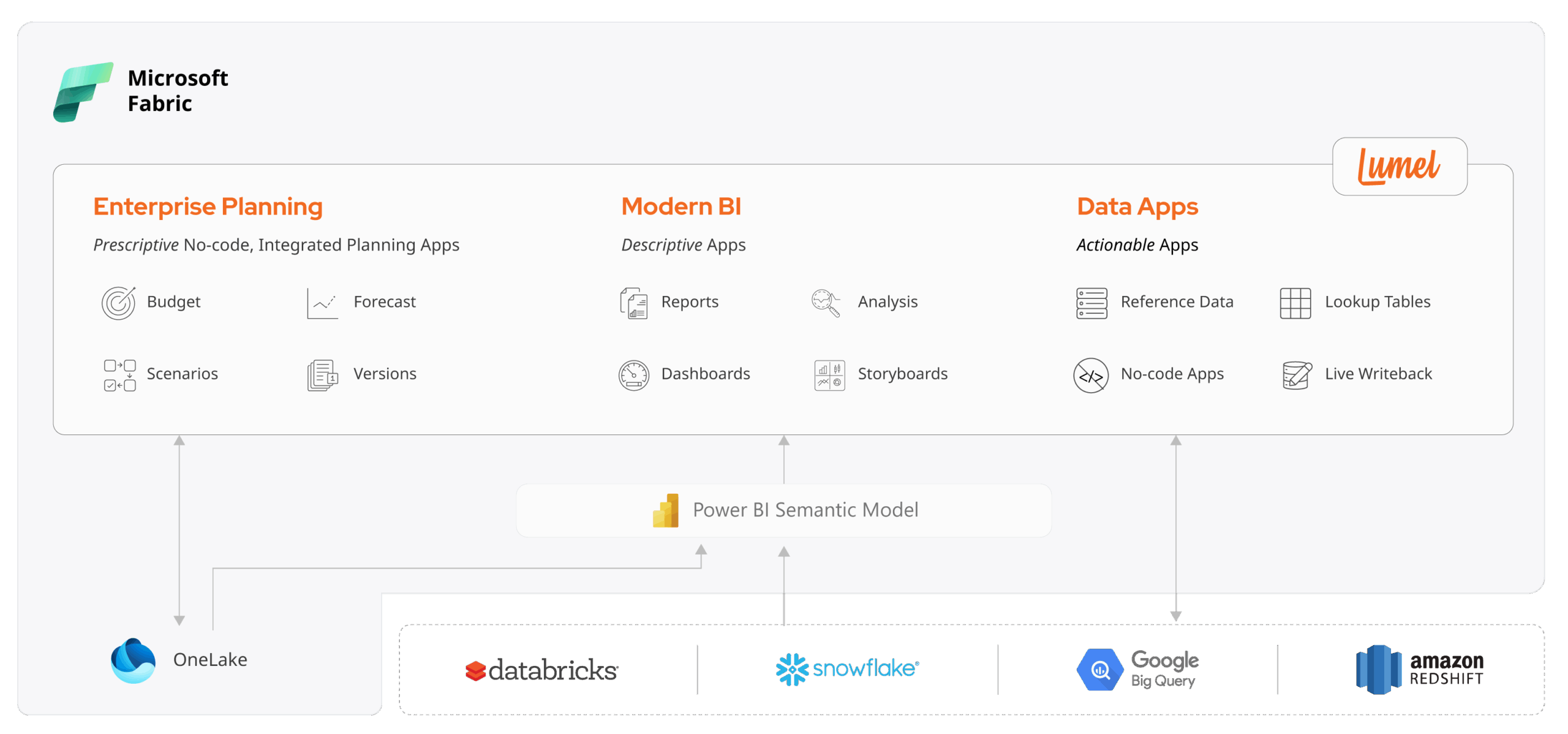
Lumel EPM enables planning software to run natively on Microsoft Fabric. This allows direct access to and processing of data, even if your data is located in other data platforms such as Snowflake, Databricks, BigQuery, or RedShift. This means you do not have to deal with data replication or complex integrations.
Lumel EPM is a comprehensive suite that consolidates and integrates three critical capabilities— Planning, BI, and Data Apps—on a single platform.
A typical workflow with Lumel EPM (as outlined in the image below) involves:
Connecting to your semantic model to retrieve updated performance data,
Using this data to develop budget models, forecasts, scenarios, and versions,
Saving these plans back to your data platform (or another destination),
Managing reference data and building apps on the same platform, and
Generating BI reports that connect directly to models or data apps for performance and variance reporting.
Throughout this process, your data remains on your data platform, eliminating the need for replication or reconciliation.
Thus, Lumel EPM consolidates three vital capabilities—planning, BI, and Data Apps—on a single platform.
Key Capabilities of Lumel EPM
No-Code, Collaborative Planning: Design budgets, rolling forecasts, dynamic what-if scenarios, and driver-based models right on your data platform. Enable authenticated commentary, threaded discussions, detailed change tracking, and audit trails for compliance.
Lumel BI for Modern Analytics: Seamlessly connect to semantic models, plans, and data apps to create integrated management and variance reports with rich visualization and filtering options.
Lumel Data Apps: Manage reference or master data supporting your reporting and planning activities. Build simple transactional or data processing apps that stay in sync with your data platform.
Designed for Business Users
Traditionally, EPM platforms are implementation-heavy and IT-managed. However, Lumel EPM incorporates a self-service, no-code architecture that helps business & finance teams get started right away.
Your business users no longer need to rely only on consultants or technical experts. They can independently create plans, budgets, and forecasts with intuitive, no-code tools. This is Self-Service EPM that speeds up strategic decision-making.
Preparing Data for AI Success
Bringing together planning and BI is essential for AI readiness. When budgets, forecasts, and actuals are all stored in a single, governed dataset within OneLake, you create a comprehensive, high-quality foundation for machine learning. This empowers your organization to move beyond simple reporting and towards predictive insights with AI. Lumel EPM will allow you to:
Monitor, review, adjust, and approve AI results
Compare user-based planning and AI-based models
Improve prediction models with user feedback and historical variance analysis
Five Distinct Advantages of Lumel EPM as a Fabric Native App
In a world where legacy SaaS planning platforms create challenges, Lumel EPM stands out as a native app in Microsoft Fabric, offering unmatched security, performance, and user experience.
Key benefits include:
Eliminate Data Duplication with a Single Source of Truth Unlike other EPM tools that require you to move, copy, or sync your data into their environment, Lumel EPM operates directly on your data within OneLake. This eliminates the need for complex and fragile ETL pipelines and prevents data silos. Crucially, your data never leaves the Fabric ecosystem. It remains secure within your tenant, governed by your policies, ensuring everyone is planning from a single, consistent source of truth.
No-Code, Business-User Focus Lumel EPM adopts Fabric’s familiar interface, allowing users to transition easily between planning and reporting in their browser. This integration boosts productivity and makes adoption straightforward - with lower technical costs and the flexibility for business users to enrich the system over time.
Connect to Any Data Platform While Lumel EPM runs natively on Microsoft Fabric, it is not restricted to data residing in the same platform. It leverages Fabric's powerful connectivity to act as a unified planning layer across your entire data landscape – including Snowflake, Databricks, Google BigQuery, and Amazon Redshift. Using features like Fabric Shortcuts, you can analyze and plan on this data from other platforms without moving or duplicating it, truly centralizing your planning and performance management.
Complete Toolbox Lumel EPM offers end-to-end support for planning, BI and data management, through features including commenting, collaboration, workflows, automation and more. It offers complete coverage for all planning methods, including top-down/bottom-up planning, integrated planning, ad-hoc planning, strategic planning, scenario planning and driver-based planning.
Unified Security & Governance As a Fabric Native App, Lumel EPM inherits your existing security model so that you need not manage a separate set of users, roles and permissions. It seamlessly respects Fabric workspace roles, Microsoft Entra ID security groups, and even the row-level security (RLS) you've defined in your semantic models. This dramatically simplifies administration and automatically enforces data governance.
EPM Pricing That Puts You in Control
Lumel is fundamentally changing the economics of Enterprise Performance Management. We have replaced the outdated model of expensive, named-user licenses and restrictive annual contracts with a simple, transparent pay-as-you-go approach that puts you in control.
This new model means:
No Annual Contracts: Say goodbye to rigid, long-term commitments. You have the agility to adapt as your business needs change.
No Named-User Licenses: You are never forced to pay for individual named users or manage license assignments. This is ideal for engaging a wide range of occasional and seasonal users without worrying about license management.
You Only Pay for Value: Our success is tied to yours. We have to earn your business every month, ensuring you only pay for the value you actually receive.
This model breaks down the cost barriers that have kept powerful EPM tools out of reach for many, including small & medium businesses (SMBs). As a result, organizations of all sizes have within their reach a complete, enterprise-grade suite with usage-based pricing.
An Integrated Future for EPM
The future of enterprise performance management is integrated, not fragmented. By combining Lumel’s native EPM suite with Microsoft Fabric’s unified platform, organizations can finally close the gap between data and decisions—enabling smarter planning and positioning themselves for success in the age of AI.