If your organization has invested in semantic models—defining measures, relationships, hierarchies, and business logic that reflect how your company actually operates—you’ve already done some of the hardest analytical work there is. Your semantic model knows your revenue structure, your cost centers, your customer segments, and your product lines.
So why does your planning process pretend none of that exists?
For most organizations, the answer is architectural: planning and analytics have always lived in different systems. Budgets get built in spreadsheets or standalone EPM tools. Actuals get reported through dashboards and BI layers. And between the two sits a gap filled with manual exports, version confusion, and broken context. The semantic model that powers your reporting has no relationship to the model that powers your forecasts.
That’s not just inefficient. It’s a strategic blind spot.
A well-built semantic model is far more than a data source for reports. It encodes institutional knowledge—how your company defines gross margin, which entities roll up into a region, how fiscal periods align with calendar months, and what “active customer” actually means in your context.
"Semantic models encode institutional knowledge"
When your planning process operates outside of this layer, two things happen. First, planning teams end up rebuilding the same logic from scratch—redefining dimensions, re-mapping hierarchies, and recreating calculations that already exist in your semantic model. This is redundant work that introduces inconsistency. Second, the plans that result from this disconnected process can’t be meaningfully compared against actuals without yet another reconciliation step.
The result is a planning cycle that’s slower than it needs to be, harder to trust, and more dependent on manual effort than any modern finance team should accept.
Imagine a different workflow. Instead of exporting data from your analytics environment into a planning tool, you build your budget directly on top of the same semantic model your reports already use. The dimensions are the same. The hierarchies are the same. The business logic is inherited, not recreated.
In this model:
This isn’t a theoretical architecture. It’s exactly how Lumel EPM works. As a native workload in Microsoft Fabric, Lumel builds planning applications directly on top of your semantic models, enabling budgets, forecasts, and scenarios that are structurally unified with your reporting layer.
The costs of maintaining separate planning and analytics environments are real but often invisible, because they’re absorbed as “just how things work.” Consider the time your finance team spends on:
None of these activities add analytical value. They’re overhead created by architectural fragmentation—and they compound with every budget cycle.
Two shifts are making this problem more urgent than it’s ever been.
The first is the consolidation toward unified data platforms. Organizations are investing heavily in platforms like Microsoft Fabric, Snowflake, and Databricks to create a single governed layer for their data. The promise is that all analytics, AI, and operational workloads can run on one foundation. But if planning remains in a separate SaaS silo, that promise is only partially realized. Your data platform has a blind spot where your forward-looking numbers should be.
The second is AI readiness. Every enterprise is exploring how AI can accelerate decision-making. But AI models—whether for forecasting, anomaly detection, or natural language analytics—are only as complete as the data they can access. If your planning data lives outside your data platform, your AI can see what happened but not what you’re planning for. Unifying planning and actuals on the same platform isn’t just about operational efficiency; it’s about making your data AI-ready in a way that disconnected tools simply cannot.
The shift from disconnected planning to semantic-model-native planning doesn’t require ripping and replacing everything at once. For most organizations, the practical path looks like this:
Your semantic models represent a significant investment in codifying how your business works. Every dimension, every measure, every relationship is a decision your team has already made about what matters and how to measure it.
Your planning process should build on that investment, not ignore it.
Organizations that bring planning to where their data already lives—on the same platform, using the same models, governed by the same policies—don’t just plan faster. They plan with more confidence, because there’s no gap between what they report and what they project.
The semantic model already knows your business. It’s time your planning did too.



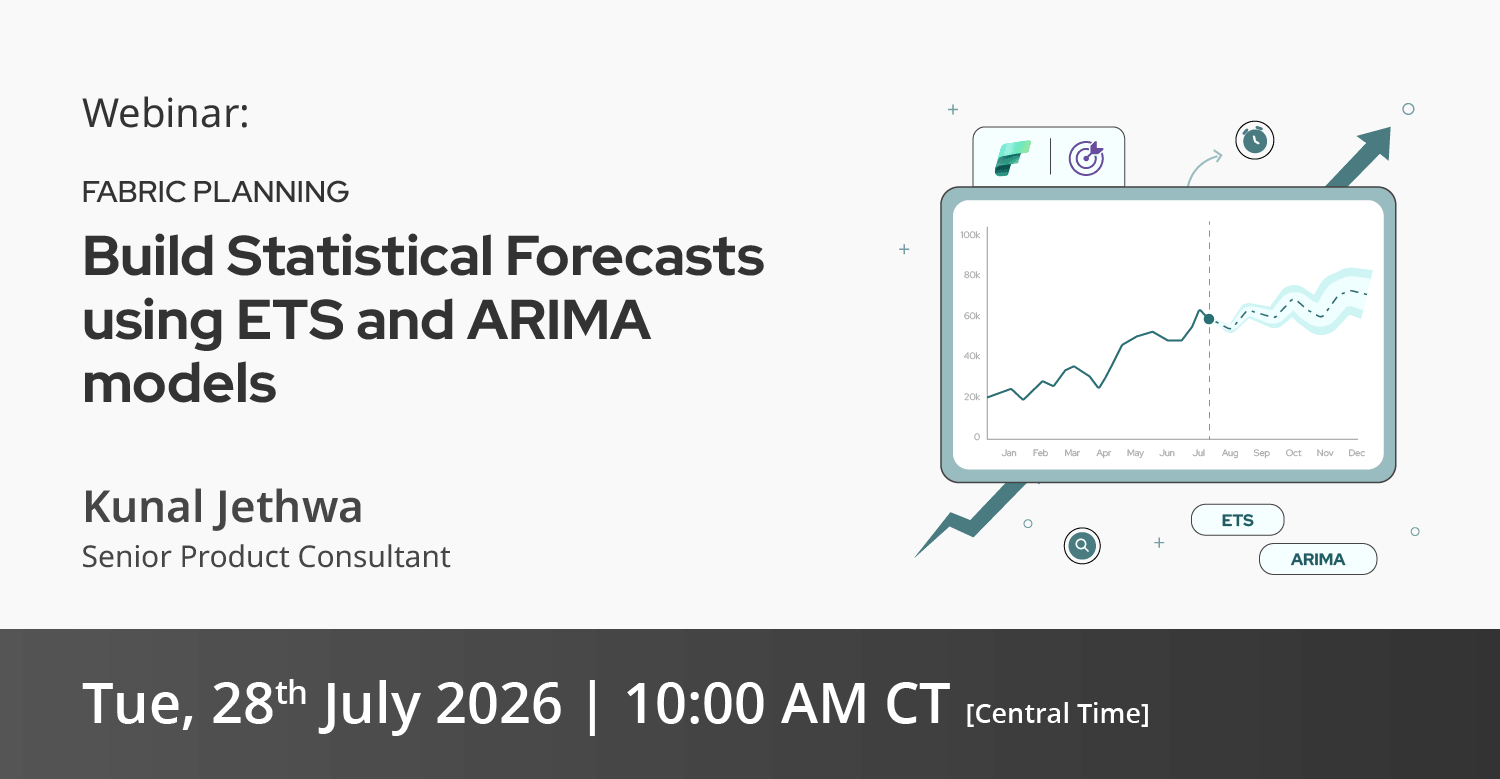
Learn how to build accurate statistical forecasts in Microsoft Fabric using the native Forecasting Engine in the Fabric Plan work item.

